

 A Bulbs
 Deco Bulbs
 Filament Bulbs
 High Watt Bulbs
 Spot Lamps
 Others
 Downlights
 Spotlights
 Panel Lights
 Flood Lights
 Street Lights
 LED strip lights
Introduction
Although many LED strip lights appear similar, their performance can differ significantly in terms of brightness consistency, thermal stability, lifespan, and installation reliability. These differences are largely determined by engineering design, component quality, and manufacturing control of different LED strip light manufacturers.
These performance differences are not driven by aesthetics or basic specifications alone. Instead, they are determined by LED quality control, PCB structure, thermal design, current regulation systems, LED density configuration, and environmental protection structure. Understanding these factors enables buyers to evaluate LED strip light systems more effectively and select solutions tailored for long-term commercial and architectural use.
LED Quality and Optical Consistency
A major factor affecting LED strip light performance is LED binning control, which refers to sorting LEDs based on brightness, color temperature, and electrical characteristics to ensure consistent optical output. High-performance systems rely on strict binning control to help maintain consistent brightness and color temperature across production batches.
In budget LED strip lights, LED bin variation often leads to inconsistent color output along the strip. This becomes more visible in long linear installations where uniform lighting is required in architectural and commercial environments.
In engineered LED strip light systems, LED selection is tightly controlled to ensure stable optical output. This improves brightness consistency and reduces visible color deviation across long installation lengths.
Color rendering performance is also influenced by LED quality and optical design, both of which impact color accuracy in retail and commercial settings.
PCB Structure and Thermal Performance Design
PCB structure (printed circuit board structure) is a key factor influencing LED strip light performance because it directly affects both electrical stability and thermal behavior. LED strip lights generate continuous heat during operation, and improper thermal design can lead to long-term degradation.
Differences in manufacturing capability among LED strip light manufacturers are particularly visible in PCB design standards. In basic LED strip light systems, thinner copper layers and simplified PCB layouts limit electrical efficiency and increase localized heat buildup, especially near connection points.
High-quality LED strip lights often use 2 oz copper PCBs to improve heat dissipation, reduce voltage drop, and maintain more stable electrical performance over long installation distances. In higher-end systems, reinforced copper traces and optimized layout design are further applied to enhance thermal distribution across the strip and reduce thermal stress on the LEDs, which helps support more stable long-term performance.
From a thermal engineering perspective, improved thermal management directly contributes to longer lifespan and more stable brightness performance under continuous operation.
Current Control and Electrical Stability
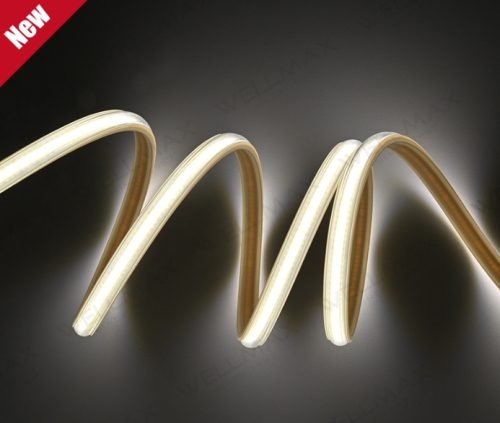
Current regulation is another key factor determining LED strip light performance. LED strip lights rely on stable electrical input to maintain consistent brightness across long installation distances.
In standard resistance-based designs, current variation caused by voltage drop often leads to reduced brightness at the far end of long LED strip installations. These standard resistor-based designs are more sensitive to distance-related power loss than regulated current systems, especially in long LED strip installations.
Advanced LED strip light systems, in contrast, use constant-current regulation to maintain stable electrical distribution along the entire strip. This improves brightness uniformity and reduces flicker in real-world applications.
Stable current control can also help improve compatibility with dimming systems and lighting controllers commonly used in commercial lighting environments.
Adhesive Quality and Installation Stability
Installation performance is also influenced by adhesive quality, which determines how securely LED strip lights remain fixed under long-term operating conditions.
In conventional systems, the adhesion layer tends to lose its bonding capability with the passage of time due to the changing conditions of temperature and humidity.
In higher-performance systems, industrial-grade adhesive materials are used to support long-term installation stability. This is particularly important in enclosed channels or architectural lighting systems where maintenance access is limited.
Although often overlooked, adhesive quality has a direct impact on installation reliability and long-term system maintenance costs.
LED Density and Lighting Uniformity
LED density significantly affects visual performance by determining whether the light output appears smooth or shows visible LED hotspots, and this design strategy also varies among LED strip light manufacturers.
Low-density LED strip light systems often produce visible light spots, especially in indirect lighting or diffused architectural applications. This limits their suitability for high-end visual environments.
High-density LED strip light systems reduce visible dotting and provide smoother linear illumination. This makes them more suitable for ceiling coves, retail shelving, and continuous architectural lighting applications.
LED density also influences thermal distribution, since higher-density configurations require more precise thermal balancing to maintain stable performance.
Waterproof Design and Environmental Protection
Environmental protection is another factor affecting LED strip light performance, especially in applications exposed to moisture, dust, or temperature variation.
Encapsulation standards vary across different LED strip light series. Standard configurations typically provide IP20 protection for indoor dry applications. In WELLMAX Eco LED Strip Series and Flexi LED Strip Series, protection levels are designed according to application environments. Selected configurations can achieve IP65 protection through silicone encapsulation for moisture resistance in semi-outdoor environments. Different protection levels balance flexibility, optical performance, and thermal behavior depending on application requirements.
Stronger environmental protection can help LED strip light systems maintain more stable performance in outdoor or semi-outdoor environments and reduce the risk of premature degradation.
Technical Specification Comparison
| Technical Factor | Standard LED Strip Lights | Engineered LED Strip Light Systems |
| LED Quality | Basic binning control | Strict LED binning and matching |
| Brightness Uniformity | Noticeable variation | High consistency across length |
| PCB Structure | Thin copper layer | Reinforced thermal design |
| Current Control | Resistor-based current limiting | Stable regulated current system |
| LED Density | Visible LED dots | Smooth linear output |
| Thermal Performance | Localized thermal accumulation | Balanced thermal distribution |
| Installation Stability | Adhesive degradation risk | Industrial-grade adhesion |
These technical factors directly determine LED strip light performance differences in real-world commercial and architectural applications.
WELLMAX Engineering Approach
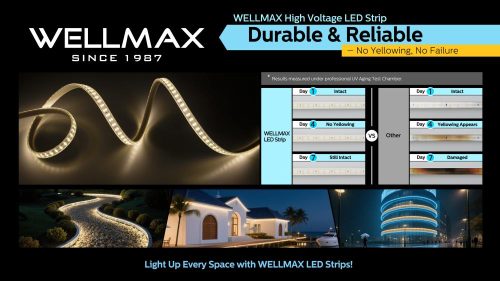
At WELLMAX, we engineer our LED strip systems within an integrated engineering framework, combining LED selection, PCB architecture, current regulation, and thermal management into a structured development workflow.
Unlike standard LED strip light manufacturers that rely mainly on component-level inspection, WELLMAX applies system-level validation before mass production. This includes multi-stage electrical stress testing, thermal performance verification, and long-term accelerated aging tests to evaluate performance stability under continuous load conditions.
Each LED strip light system is tested not only for basic functionality, but for long-term degradation behavior, including lumen maintenance stability, thermal drift behavior under operation, and voltage fluctuation tolerance across extended installation lengths. This allows potential failure risks to be identified before production release rather than during field operation.
In addition, system compatibility between LED modules and drivers contributes to stable performance across different installation environments and project requirements.
Conclusion
LED strip light performance differences are determined by multiple engineering factors, ranging from LED quality control, PCB thermal design, current regulation systems, LED density to environmental protection structure. These factors vary noticeably among LED strip light manufacturers.
These technical factors define whether LED strip light systems can maintain stable brightness, consistent color output, and reliable long-term operation in real applications. For commercial and architectural lighting projects, engineering-driven selection helps improve performance predictability and reduce maintenance risks.
Call to Action: LED Strip Light Project Technical Support
For commercial LED strip light projects, engineering validation is essential before procurement. WELLMAX provides technical support for specification review, thermal analysis, and system compatibility evaluation.
You can:
- Submit project drawings for technical assessment
- Request LED strip light specifications and compliance documents
- Receive thermal and electrical design guidance
- Discuss customized LED strip light solutions for your application
Visit the WELLMAX official website to connect with our engineering team and request a project quotation.
FAQ
Q: How does PCB copper thickness affect LED strip performance?
PCB copper thickness directly impacts LED strip light thermal performance and electrical stability. A thicker copper layer (such as 2 oz PCB) improves heat dissipation, reduces voltage drop, and helps maintain consistent brightness over long LED strip installations.
Q: How do I choose the right LED density for LED strip lights?
LED density affects lighting uniformity and visual performance. Lower density LED strip lights may create visible hotspots, while higher density LED strip lights provide smoother linear lighting, making them more suitable for architectural and commercial lighting applications.
Q: What is the sample lead time for LED strip light customization projects?
Sample lead time depends on configuration complexity. Standard models follow a short engineering preparation cycle, while customized LED strip light systems require additional validation of LED binning, PCB structure, and thermal performance before sample approval.
Q: How does WELLMAX handle product quality issues after shipment?
WELLMAX provides batch-level traceability for each LED strip light order. When a quality issue occurs, the production batch, material records, and testing data are reviewed to identify the technical root cause and determine whether it relates to installation conditions, electrical configuration, or manufacturing deviation.
Q: How does WELLMAX reduce delivery–delay risks in large projects?
WELLMAX uses structured production scheduling and material planning systems to reduce uncertainty in bulk orders. Project timelines are coordinated with testing cycles and material availability to ensure more predictable delivery performance.