

 A Bulbs
 Deco Bulbs
 Filament Bulbs
 High Watt Bulbs
 Spot Lamps
 Others
 Downlights
 Spotlights
 Panel Lights
 Flood Lights
 Street Lights
 LED strip lights
Introduction
In commercial lighting procurement, LED downlight selection directly impacts installation stability, energy performance, and long-term maintenance costs. Buyers in global distribution channels no longer focus only on wattage or price. Instead, they evaluate optical output, thermal stability, driver reliability, and compliance documentation before confirming bulk orders. As an LED light China manufacturer, WELLMAX designs LED downlight systems for project-level applications where performance consistency and technical verification are essential.
What Is an LED Downlight and Where Is It Used in Ceiling Lighting?
An LED downlight is designed for recessed or surface-mounted installation in architectural spaces, providing controlled beam-angle lighting with low glare. It is widely used in commercial interiors where visual comfort and uniform illumination are required.
We engineer our downlight systems for demanding commercial settings, including offices, retail stores, transit hubs, and hospitality venues. In these spaces, lighting must stay bright, stable, and reliable over long-term use. Stable lighting helps improve visual comfort, supports daily operations, and keeps public areas safer for occupants and visitors.
How to Classify LED Downlight Types for Different Projects
LED COB Downlight for Precision Lighting
COB LED downlights are typically used in applications requiring concentrated beam control and higher-intensity output. The COB light source enables tighter optical focus, making it ideal for accent lighting in retail and display environments.
LED Recessed Circular Downlight for Architectural Integration
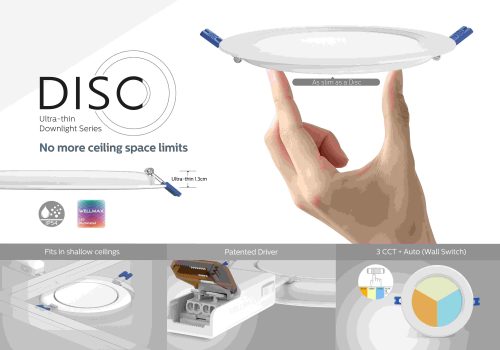
The LED recessed circular downlight is designed for ceiling integration where a clean ceiling appearance and visual consistency are required. It provides a clean installation appearance while maintaining stable light distribution across commercial spaces.
LED Surface Downlight for Flexible Installation
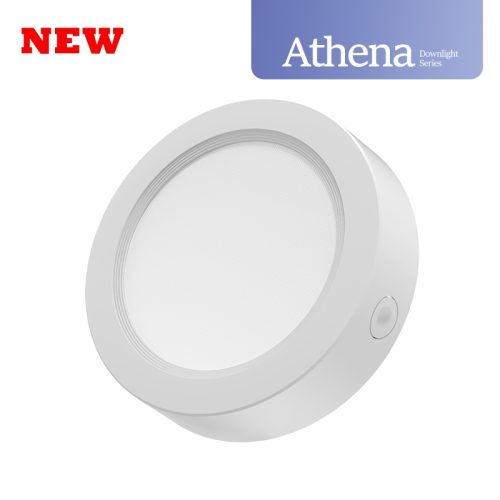
LED surface-mounted downlights are used where ceiling cutouts or recessed mounting are not feasible. They offer flexible installation while ensuring consistent optical performance and thermal stability.
What Parameters Define LED Downlight Quality?
LED downlight quality is defined by measurable engineering parameters rather than appearance. In B2B procurement, these parameters determine whether the product is suitable for long-term commercial operation or only short-term use.
We evaluate LED downlight systems based on optical output, electrical stability, thermal design, and validation testing. Each parameter directly affects performance consistency in real-world installation environments.
Optical Performance Parameters
Optical performance defines how efficiently electrical energy is converted into visible light.
Key indicators include:
- Luminous efficacy (lm/W)
- Color Rendering Index (CRI)
- Beam angle control
- Light uniformity across ceiling surfaces
High-performance systems typically achieve 100–130+ lm/W depending on driver and system design. CRI above Ra80 is highly recommended for commercial environments where visual accuracy is important.
Driver System Stability
The LED driver determines current stability and directly affects flicker performance and lifespan.
In professional systems, we use:
- Constant current drivers
- Isolated driver architecture
- Surge protection design
Unstable driver systems are one of the most common failure points in LED lighting, especially in high-temperature environments.
Thermal Management Design
Thermal performance determines long-term degradation speed and lumen maintenance.
We focus on:
- Aluminum housing heat dissipation
- Internal thermal pathway optimization
- Junction temperature control
- Driver heat separation design
Stable thermal performance helps support longer L70 lifespan and reduces early lumen decay in high-load applications.
Reliability and Testing Standards
Reliable LED downlight systems should go through structured validation processes before mass deployment.
Key testing methods include:
- LM-80 data for LED light sources
- IES photometric files for light distribution verification
- Accelerated aging tests
- EMC testing
- Automated photometric inspection
These tests help verify performance under different voltage and temperature conditions.
Mechanical Structure and Installation Compatibility
Mechanical design determines installation efficiency and long-term structural stability.
We evaluate:
- Housing material strength
- Ceiling compatibility (cut size accuracy)
- Heat-resistant construction
- Installation method (recessed or surface-mounted)
This directly affects whether the product can be deployed across large-scale projects without modification issues.
Technical Comparison of LED Downlight Performance Levels
| Parameter | Entry-Level LED Downlight | Project-Grade LED Downlight |
| Luminous Efficacy | 80-90 lm/W | 100-130+ lm/W |
| CRI | Ra70+ | Ra80-Ra90 |
| Driver Type | Basic IC driver | Constant current isolated driver |
| Thermal Design | Standard aluminum body | Optimized thermal structure |
| Lifespan (L70) | 20,000-25,000 hours | 30,000-50,000 hours |
| Testing Level | Basic inspection | comprehensive photometric and aging validation |
Performance differences come mainly from driver design, thermal engineering, and testing depth rather than LED chip selection alone.
How Manufacturing Capability Impacts LED Downlight Quality
LED downlight performance is strongly linked to manufacturing capability rather than component selection alone. A qualified LED manufacturer in China should integrate R&D, testing, and automated production systems.
In our production system, we focus on:
- In-house optical R&D development
- Automated photometric inspection
- Multi-stage quality control process
- Driver and chip compatibility testing
- Failure rate tracking over production cycles
Manufacturers with limited testing capability may have greater batch-to-batch performance variation.
Application Fit: Choosing the Right LED Downlight Type
Different project environments require different LED downlight structures. Here are several examples:
- LED recessed circular downlightsareused in clean architectural ceilings requiring uniform lighting
- LED surface-mounted downlights are used in retrofit or non-recessed ceiling applications
- COB LED downlightsareused for focused lighting in retail and display zones
Correct selection improves installation efficiency and reduces long-term maintenance issues.
Engineering Support and Global Project Adaptation
Professional LED downlight systems must adapt to different voltage environments, installation standards, and compliance requirements.
A capable China LED light manufacturer must provide:
- Photometric IES files for lighting simulation
- Compliance documents(CE, RoHS, etc.)
- Thermal performance reports
- Product lifetime validation data
- Application-based lighting design support
Global compatibility is essential for distributors operating across multiple markets.
WELLMAX Engineering Approach in LED Downlight Systems
As an experienced lighting manufacturer, we design LED downlight solutions with a focus on thermal stability, optical precision, and long-cycle reliability.
Our engineering system emphasizes:
- Advanced LED chip integration with driver matching
- Full photometric and aging validation
- High-efficiency thermal management design
- Compliance with international lighting standards
This helps support stable performance across commercial and industrial applications worldwide.
Conclusion
LED downlight selection should be based on measurable engineering parameters rather than surface-level specifications. Optical output, driver design, thermal performance, and testing validation collectively determine whether a product can support long-term commercial use.
For bulk procurement, working with a technically capable LED lighting partner supports long-term project stability and helps reduce maintenance risk.
Request Technical Support or Quotation
WELLMAX supports project-based LED downlight selection with technical consultation, photometric file review, and bulk quotation analysis. You can upload specifications for evaluation and receive engineering-level product selection support.
FAQ
What is the most important performance indicator in LED downlights?
Luminous efficacy, lumen decay and thermal stability are the key indicators because they directly affect energy efficiency and lifespan performance.
How does LED driver quality affect performance?
How does LED driver quality affect performance?
LED driver quality affects how steadily power is supplied to the light source. A stable driver helps control current output, while poor design can lead to flicker, unstable lighting, and shortened product life.
What documents should be requested before bulk purchase?
LM-80 reports, IES files, thermal test reports, and photometric data are essential for verifying real performance.
Can LED downlights be used in all ceiling types?
Different installation environments require recessed or surface-mounted structures depending on ceiling conditions. Our LED downlight range offers different options for customers, including surface-mounted models and recessed models. For recessed installation, selected products also support a certain range of cut-out sizes, giving buyers more flexibility when matching different ceiling openings.