

 A Bulbs
 Deco Bulbs
 Filament Bulbs
 High Watt Bulbs
 Spot Lamps
 Others
 Downlights
 Spotlights
 Panel Lights
 Flood Lights
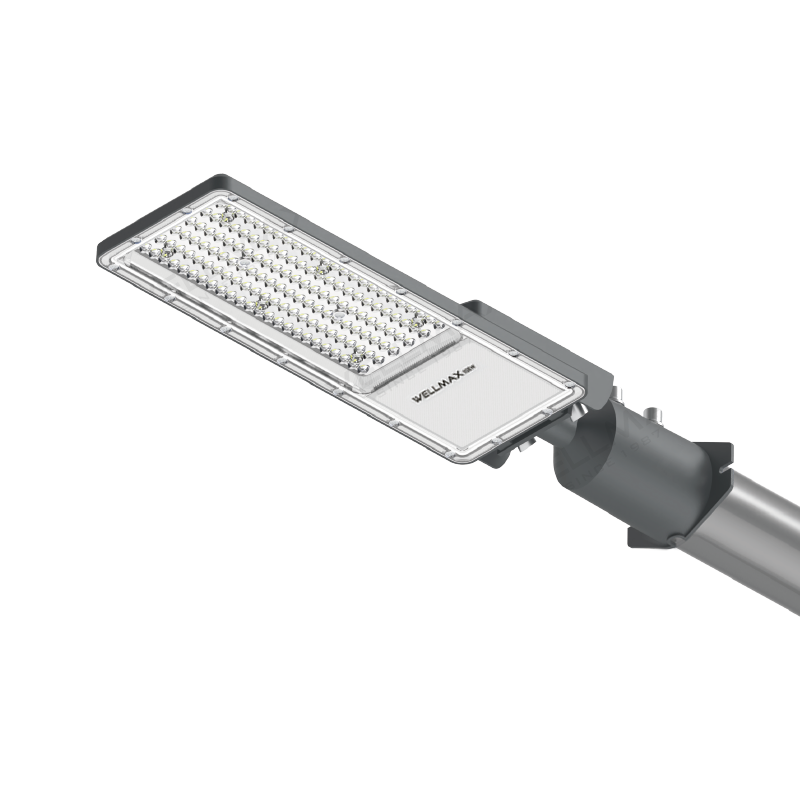 Street Lights
 LED strip lights
Choosing the proper lighting fixture for either industrial or commercial applications depends on a thorough knowLEDge of how light beam angles work. It is not just a matter of choosing flood lights or spotlights; rather, choosing one or the other affects safety, visibility, and even energy usage in a particular application.
Flood lights are designed to emit light evenly onto a broad area. This type of light can be used effectively in outdoor work areas, loading zones, and parking lots. Spotlights, on the other hand, produce a focused beam suitable for long distances and high-intensity applications, such as signage and building facades.
The width of the light beam is important. Choosing the wrong one means your space either looks like a dark cave or a blinding runway. Neither is good for business.
At WELLMAX, we have been helping partners spec the right LED lighting products for nearly 40 years. Here is a practical, no-nonsense guide to picking between flood lights and spotlights based on real-world performance data.
Defining the Beam: The Technical Cutoff
Most industry standards draw the line at 45 degrees.
- Spotlightstypically have a beam angle of less than 45°. They project a concentrated, high-intensity light suitable for pointing at specific objects.
- Floodlights usually have a beam angle of 45° to 120°. They distribute light across a wide area for uniform illumination.
Flood Lights vs. Spotlights: Quick Comparison
| Comparison Item | Flood Lights | Spotlights |
| Beam Angle | Usually 45°–120° | Usually below 45° |
| Lighting Effect | Wide and even coverage | Narrow and focused beam |
| Best For | Parking lots, loading docks, storage yards | Signage, facades, long-distance targets |
| Main Benefit | Covers larger areas | Delivers higher intensity in a focused direction |
| Key Risk If Misused | Light spill or wasted energy | Uneven coverage or dark areas |
Why Application Dictates Selection
Choosing the right fixture depends entirely on what you are trying to light.
Use Spotlights (<45°) when you need:
- Accent lighting:Illuminating flags, signage, or specific architectural features.
- High-bay stacking:Narrow beams reach higher with less scattering in warehouses.
- Security perimeters:Focusing light down a long fence line or gate.
Use Flood lights (>45°) when you need:
- General area lighting: Parking lots, loading docks, or construction sites.
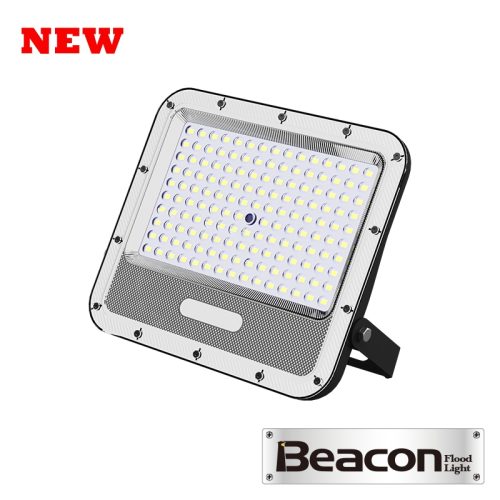
- Vertical surfaces: Illumination for walls, billboards, or building exteriors.
- Open spaces: Warehousesor large storage yards where uniform light is required.
For example, our Beacon Flood Light uses a precise 90° beam angle, balancing broad coverage with sufficient surface illuminance for safety. Using a 120° lens on the same housing may reduce light intensity below optimal levels.
Performance Specifications to Check
When you are evaluating China LED lights for bulk orders, do not just look at the wattage. Look at these three specs:
- Luminous Efficacy (lm/W)
This tells you how efficient the LEDlight bulb (or fixture) is.
- Standard industrial lights: 80-90 lm/W.
- High-performance options (like our WELLMAX flood lights): 120-150 lm/W .
Why it matters: A high-quality 100 watt LED flood light at 150 lm/W gives you 15,000 lumens. A cheap 100W light gives you only 9,000. Higher efficacy reduces energy while ensuring required brightness.
- Ingress Protection (IP) & Impact (IK)
Outdoor gear gets beaten up.
- IP65is dust-tight and protected from low-pressure water jets.
- IP66ensures complete dust protection and resistance to powerful water jets.
- IK08or IK10 indicates the glass and housing can withstand physical impact (vandalism or forklifts).
- Surge Protection
Industrial sites have dirty power. Look for 2kV to 10kV surge protection. Without it, a summer thunderstorm mayfry your drivers.
Real-World Scenarios: Flood Lights vs. Spotlights
The Billboards
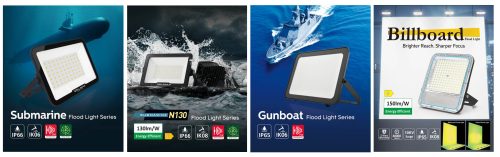
Even illumination across the full surface ensures readability; avoid narrow hotspots. Our Billboard Flood Light uses a 90° beam with a 150 lm/W efficacy to ensure the ad is readable edge-to-edge.
The Warehouse Perimeter
Flood lights cover wide horizontal areas effectively. A narrow spotlight may be used only to illuminate distant fence lines.
The WELLMAX Manufacturing Advantage
Why work with us? It comes down to consistency.
As a leading lighting company that handles OEM/ODM, we ensure your LED lighting products have stable color temperature (CCT) and high CRI, whether you order 500 or 50,000 units.
We also focus on SKD-friendly designs. Our Beacon and Submarine series feature a no-glue screw-lock design. This means you can ship them flat to save volume (up to 66% space) and assemble them locally without a technical degree.
Call to Action: Let’s Build Your Lighting Plan
Ready to spec the right lights for your next project? Whenever you need a sample of our 100W LED flood light for testing or a quotation for a full container of 200W LED flood light units, our technical sales team is ready.
Contact WELLMAX today to get a specification sheet and a bulk quotation.
FAQ
Q: Can I use a flood light as a spotlight?
It may produce suboptimal results. Flood lights lack the optical design to focus light over long distances, potentially reducing intensity and increasing light spill.
Q: How do I calculate the coverage of a flood light?
A quick rule of thumb is: Beam Width = Beam Angle x 0.018 x Distance. For a 100W LED flood light with a 90° beam placed 10 meters high, the beam width is roughly 16 meters.
Q: What is the average lifespan of an industrial LED flood light?
With quality drivers and effective thermal management, most LED flood lights can achieve 30,000–50,000 hours of operation. Our Billboard series, for example, is rated for 40,000 hours with a 5-year warranty.
Q: Does a higher wattage always mean a brighter light?
Not necessarily. Lumens, not watts, determine brightness. An efficient 100W LED may produce 15,000 lumens, while a cheap 200W light might only yield 14,000 lumens. Check lm/W efficiency.